Informational article. This content does not replace medical, agricultural, nautical or other professional advice. Lunar data is approximate.
The relationship between celestial bodies and life on Earth has been studied for millennia. For those who dedicate their lives or free time to fishing, understanding how the phases of the moon influence fish behavior is not mere superstition, but a fundamental technical tool. The success of a fishing trip often depends on factors beyond the equipment used; the position of our natural satellite and its monthly cycle dictate many of the biological rhythms in rivers, lakes, and oceans. By consulting a lunar calendar , anglers can anticipate times of peak activity and periods of dormancy, significantly optimizing their efforts.
How the phases of the moon influence sport and artisanal fishing
The Moon's influence manifests primarily through two mechanisms: luminosity and gravity. The light reflected by the moon affects nighttime visibility and feeding patterns, while gravitational pull generates tides, which drive the movement of nutrients in the sea. In freshwater environments, although tides are not perceptible, atmospheric pressure and light still play a crucial role. Fish, as ectothermic organisms, depend on their environment to regulate their energy, and changes in the lunar cycle act as biological triggers for feeding or seeking shelter.
The solunar theory and its practical application
At the beginning of the 20th century, John Alden Knight systematized traditional knowledge into what we now know as the solunar theory. This theory proposes that there are 'major' and 'minor' periods of animal activity based on the moon's position relative to the observer. Major periods occur when the moon is directly overhead (transit) or directly overhead (opposition), while minor periods occur at moonrise and moonset. Integrating this data with the lunar phases allows for the creation of a precise map of when fish will be most likely to bite.
When is the full moon and what effect does it have on fish activity?
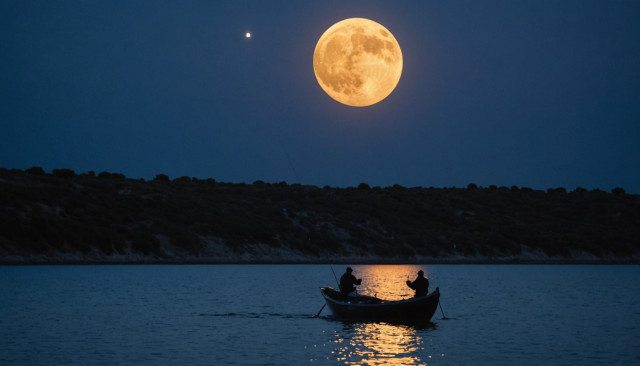
The full moon is perhaps the most debated phase among anglers. During this period, the moon's brightness is at its maximum, allowing predators to hunt more easily throughout the night. This often means that by dawn, many fish are already satiated and their activity decreases during the day. However, for night fishing, the full moon offers unique opportunities, especially with species that rely on sight to hunt.
The visibility and behavior of predators
On nights with a full moon, light penetrates to greater depths, activating the food chain from plankton to large predators. It's common to observe that species like bass or trout become more aggressive at the surface. However, the excess light can also make fish more cautious, as they themselves are more visible to their predators. Therefore, the use of lures that generate vibrations or have distinct silhouettes is vital during this phase.
What does the new moon mean for the success of the day?
The new moon marks the beginning of a new cycle and is widely considered by many experts to be the best time for fishing, especially during the day. With no moonlight at night, fish tend to feed less in the dark and arrive at dawn with a strong urge to hunt. This phase often coincides with stronger tides, which stir up the seabed and bring a large amount of food into suspension.
Fishing strategies on nights of total darkness
During the new moon, total darkness forces fish to rely more on their lateral line and sense of smell. For anglers, this means that dark-colored lures (which create a strong contrast against the dim sky) and baits with potent scents are extremely effective. Activity is typically concentrated in twilight hours, when the change in light triggers their most primal hunting instincts.
How the moon affects the tides and the movement of water
It's impossible to talk about fishing without mentioning the tides, and these depend directly on the lunar calendar . When the moon and the sun align (new moon and full moon), their gravitational forces combine, creating what are known as spring tides. These tides have a maximum amplitude, with very high high tides and very low low tides. The massive movement of water carries small crustaceans, forage fish, and nutrients, attracting larger species toward the coast or the entrances to estuaries.
Spring tides and neap tides in the lunar calendar
Conversely, during the first and last quarter moons, the forces of the sun and moon counteract each other, resulting in neap tides. On these days, water movement is less and the current is weaker. While this might seem like a disadvantage, it's the ideal time to fish in areas where strong currents often make handling tackle difficult, or to target species that prefer calmer waters.
The lunar calendar as a tool for the modern fisherman
Nowadays, anglers don't need to observe the sky every night to know what phase the moon is in. Using a digital lunar calendar allows them to plan fishing trips months in advance. By cross-referencing lunar phase information with local tide tables and weather forecasts, the element of chance is reduced. A good angler knows that the moon doesn't guarantee a catch, but it does increase the odds of being in the right place at the right time.
Behavior of specific species according to the lunar cycle
Not all fish react to lunar stimuli in the same way. Pelagic species, such as tuna and swordfish, have daily vertical migrations that are altered by moonlight. In inland waters, largemouth bass are known for their sensitivity to phase changes, exhibiting notable spikes in aggression in the days leading up to a full moon. On the other hand, bottom-dwelling species like catfish and sole depend more on tidal movements than on surface light.
Freshwater fish and their sensitivity to pressure
In lakes and rivers, where there are no tides, the moon influences fish behavior through subtle changes in pressure and magnetoreception. Many freshwater species have been documented to synchronize their spawning periods with specific lunar phases to ensure the survival of their offspring, taking advantage of times of greater nutrient dispersion. Understanding these reproductive cycles is essential for practicing responsible and sustainable fishing.
First quarter and last quarter: transition periods
These intermediate phases are often overlooked, but they offer a stability that can be very productive. During the first quarter, activity tends to increase gradually as the nights become clearer. It's an excellent time to try different depths, as fish begin to move more erratically through the water column. The last quarter, following the full moon's frenzy, is usually a period of moderate but steady activity, ideal for technical and precision fishing.
Tips for making the most of the moon's phases on your next outing
To maximize your results, it's advisable to keep a fishing log or journal, noting the lunar phase, tide conditions, and catches. Over time, this log will reveal specific patterns for your usual fishing spots. Additionally, it's crucial to adapt your lure color and action: natural, bright colors for clear nights, and solid or fluorescent colors for dark, new-moon nights.
Summary of activity by lunar phase
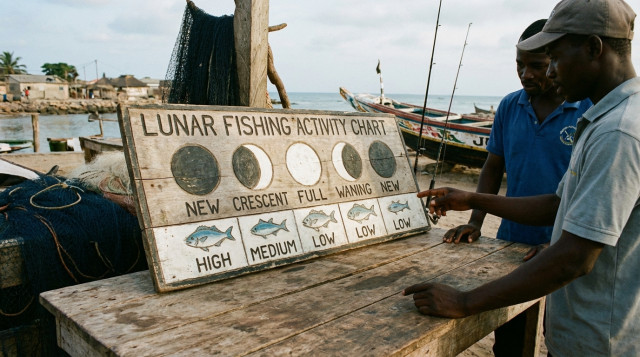
| Lunar Phase | Activity Level | Best Time | Type of Tide |
|---|---|---|---|
| New moon | Very High | Day and Twilight | Spring Tide (Maximum movement) |
| First Quarter | Moderate | Late afternoon and early evening | Neap Tide (Gentle Current) |
| Full moon | High (Night) | Night and Dawn | Spring Tide (Maximum movement) |
| Waning Crescent | Low / Moderate | Tomorrow | Neap Tide (Gentle Current) |
Finally, it's important to remember that the moon is just one of many factors that influence the aquatic ecosystem. Wind, water temperature, turbidity, and barometric pressure can all enhance or negate the lunar effect. However, by mastering the interpretation of the lunar calendar , anglers gain a competitive edge and a deeper connection to the rhythms of nature, transforming each outing into a constant learning experience about the fascinating underwater world and its dependence on celestial cycles.